Taking your dog to an off-leash dog park, where he can roam free and socialize with other dogs, would seem to be very beneficial for both you and your pet – you satisfy your desire for your pet to exercise, and he develops socialization skills. But there are caveats and warnings that deserve discussion.
Animals must always be accompanied by their owners, and there are a few responsibilities when taking your dog to such an environment that you must consider. A dog park is not the place to visit with your dog as a substitute for walking it. To release mental frustration, one should first walk or exercise the dog before entering the park, otherwise excited mental energy could turn into a possible fight when your dog confronts the others.
It’s been my experience that too many people make the mistake of letting their animals run free, and completely disconnect the entire time their dogs are out playing and socializing. A dog whose owner turns it loose, then turns his back, is not under control. Sitting on a bench chatting, until it’s time to go home, means that you are potentially ignoring maintaining leadership of your dog, and inviting problems.
A responsible owner will make sure that his pet is in view at all times, and will be observing the body language of the animal, to ensure the pet’s safety and fun. The animal must always be under the owner’s control, and attention must be paid to dog “body language” with the other dogs that he encounters. High-set, slow-wagging tails, or not wagging at all, or ears pinned back, are signs warning that either dog is considering a possible conflict. Be quick to intervene, as it’s never a good idea to separate a dog fight, even for those with experience.
Don’t let your dog or other dogs mount each other, as this is sign of domination, and it’s important to ensure that the dogs in the park know that the owners are the dominant ones, and not the other way around. Mounting elevates excitement and can lead to a possible conflict.
It’s not a rule at all dog parks, but I believe that it should be; all dogs entering the dog park should be neutered. This is not the place to bring an intact male, or a female in heat. These animals cause intense excited energy, and a fight is almost a sure thing.
Make sure that running dogs are not actually chasing a dog that might be a weak, submissive animal. It’s natural in the wild for dogs to eliminate dogs in the pack that are weak, but that shouldn’t be happening in the dog park. Intervention by breaking the pack up, and sending each dog away from the weak dog, is immediately necessary. The weak dog should never be picked up; this only excites the rest, and they will start jumping at you to get at the victim.
Some dogs tend to ignore the social cues and greeting procedures of the other dogs. Ignoring dog greetings like sniffing, they leap in to play, putting paws on other pets, seemingly unaware that another dog is standoffish or dislikes this type of advance. These dogs also cause problems for fearful animals, who often resort to “fear biting,” especially if they’ve been victims of an aggressive dog in the past.
The sometimes controversial “Dog Whisperer” Caesar Milan has this suggestion – “Often, the best way for a dog to learn how to behave is from another dog. Reach out to a friend or neighbor with a well-socialized dog, and ask them to join you and your dog on walks. Preferably, this dog will also have a calmer energy than your own. Take your dogs on long walks together, and allow your dog to see the correct behavior from a well-socialized dog. If you don’t have a friend or someone to reach out to with a well-socialized dog, try reaching out to local trainers or rescue groups who may be able to help.”
Another big “no no.” Small children should never be included in a trip to the dog park. Many pets accept petting and touching from strange adults, but noisy, animated kids and an unbidden approach to an appealing puppy or dog are frightening to an animal that has not been raised or socialized with little human beings. This is when bites happen, and, following a seemingly innocent attempt to pet or play, a perfectly friendly dog can become aggressive with children for life.
Now a real biggie: Dogs can’t clean up after themselves outdoors. Unfortunately, most owners don’t either. Many dog parks provide waste bags, and receptacles for disposal. If you pretend that you don’t see your puppy squatting behind a bush a few yards away, believe me, someone else does, and you will be reminded that you need to get busy. Carry a bag at all times.
A few interesting poop pick-up facts, who does, and who doesn’t?
“A survey of 1,000 people across the state by the N.C. Department of Environment and Natural Resources and East Carolina University Center for Survey Research, found that people aged 18 to 24 years and 65 years and older are most likely to report they always or often pick up pet waste. Two age groups tied for the least likely to pick up poop: 35-to 44-year-olds and 45-to 54-year-olds.
The pros and cons of public dog parks will be discussed, with
Pooch Pines
passion forever. Topics always include possible diseases and parasites that may or may not be lurking there, people who don’t pick up, if a pet is too large for a particular designated area, ad infinitum.
How will you and your dog fit into the pecking order, if you choose to go to a dog park? That can’t be predicted, but follow a few rules, enjoy, and remember that keeping your pet safe is always your job.
Miami is the place to go if you want some fun in the sun and frolicking on the beach, but it’s also full of historical places that are worthy of your attention. There are more than a dozen of these notable historical landmarks in Miami, but the one treasure that stands out foremost in the minds of many visitors and residents alike is Vizcaya Museum and Gardens.
the north Coconut Grove area, is one of the most magnificent museums in the continental United States, as it contains an extremely important collection of artwork and historic artifacts unique among such collections. Additionally, the glorious exterior of the main house was constructed with local coquina limestone, yet has the timelessness of Florence, the gaiety of the Rococo and the glory of Rome, combined in one grand design.
An interesting fact about this estate is as follows: half-brothers Charles and James Deering, sons of wealthy industrialist William Deering, with Charles’ mother being Abbey Reed Barbour and James’ mother being William’s second wife, Clara Hammond Deering, both fell in love with the tropical landscape of Southeast Florida, as many people do, as their father had a winter home in Coconut Grove. After their father’s death they both built their monumental estates in the area: Charles constructed the Deering Estate and James developed Vizcaya.
James, a member of the social elite and an antiquities collector, left a legacy that has enthralled many and will do so for generations. He developed one of the most beautiful places on earth.Consisting of 180 acres on Miami’s Biscayne Bay, the European-inspired estate included the Main House, ten acres of formal gardens, lagoons and islands to the south, and a village that had fruit groves, vegetable and flower gardens and staff residences. Today, this National Historic Landmark preserves 50 acres, 10 acres which includes the European-inspired formal gardens, and 40 acres of native hardwood hammock. The villa’s museum contains 34 rooms of distinctive architectural interiors decorated with numerous antiques, with an art and furnishing collection that spans 2,000 years.
Construction began in 1910 and James wintered there from 1916 until his death in 1925. Vizcaya is distinguished for its Italian Renaissance inspired Mediterranean Revival architecture, its huge Italian Renaissance revival gardens, and lavishly designed, detailed, and executed interior architectural elements with European, Asian, and American furnishings, art and antiquities that span two millennia. The numerous sculptures in the gardens and villa are of ancient Greek, Greco-Roman, and Italian Renaissance origins and styles that reflect James’s desire to showcase art along with the indigenous natural beauty. Vizcaya, unlike other historic house museums, contains the original antiques, furnishings and art thanks to its heirs, who allowed this to happen as long as the estate is used as a public museum in perpetuity.
Joel Hoffman, Executive Director of Vizcaya.
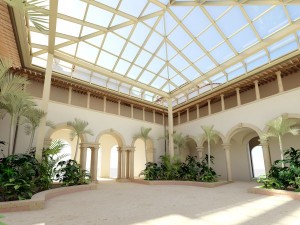
In 1994 Vizcaya was designated a National Historic Landmark, with an open-air courtyard and extensive gardens on Biscayne Bay and has been undergoing a restoration. Part of this renovation includes installing a glass canopy to replace the protruding glass-and-steel pyramid that covers the courtyard. The canopy will let in more natural light and will be coated to block out heat and ultraviolet radiation.
This $2.7 million project was completed as part of a $50 million renovation of the museum.Joel Hoffman, Executive Director of Vizcaya Museum and Gardens discusses this renovation of the skylight in Vizcaya’s Main House.
Marla E. Schwartz: How will the renovation of the courtyard skylight be different from its previous incarnation?
Joel Hoffman: Vizcaya was built as a winter home and, after it became a public museum, operations extended year-round. Although South Florida is known for its appealing climate, the heat, humidity, sunlight and salt air don’t exactly make for a museum-quality environment. Vizcaya’s Courtyard was first covered in the 1980s to protect the collection from destructive natural elements. At the same time, air conditioning was installed in the house, providing substantially improved conditions for our collections and those who came to see them throughout the year. Conservators recently conducted a comprehensive survey of our interior collections and the good news is that our artworks and furnishings appear to be stable. So our predecessors did a wonderful service for Vizcaya, our community and the art world at large by undertaking that project more than 25 years ago.
Vizcaya canopy rendering of what it will look like after the current renovation.
We decided it was time to replace the original skylight because it was leaking and not compliant with Miami-Dade County’s stringent hurricane requirements, put in place after Hurricane Andrew. The Federal Emergency Management Agency (FEMA) granted us $1.4 million toward this project, with the balance of funding coming from Miami-Dade County’s Building Better Communities General Obligation Bond. We also were excited about building a new skylight that would be more sympathetic to Vizcaya’s historic architecture.
While we can’t re-open the Courtyard to the exterior, we focused our redesign efforts on making the new skylight as transparent as possible. We’d like to think our visitors will feel like they’re standing outside when they’re in the Courtyard under the new skylight. We know that’s not possible beneath an enclosed structure of metal and glass. But, happily, the new skylight will be much lighter and brighter than the first thanks to technological advances. The 2012 skylight, for example, will have glass panels that are about three or four times larger and much clearer, a substantially simpler structure, and a light, off-white surface that we think will blend with the sky far better than the dark brown metal of the original skylight. These qualities should also provide better views of interesting rooftop elements from within the house.
We’re also using this opportunity to install larger, native trees and other plants in the planters that surround the Courtyard. These are based on research into the original plantings in this space and are intended to re-connect the house with the natural forest that surrounds it.
One of the most complicated aspects of this project was devising a system for protecting our architecture, artwork and visitors during construction. The protection began with the installation of plastic dust barriers around the perimeter of the Courtyard and the enclosure of vulnerable artifacts in bubble wrap and plywood. The contractor, Thornton Construction Company, then filled the Courtyard with scaffolding and suspended a plywood wall around its edge to create another layer of protection. A most important part of this structure is the platform that was built atop the scaffolding to provide a place for workers to dismantle the old skylight, repair the roof, and erect the new skylight piece-by-piece. And, yes, the summer is a challenging time to do this project, given the constant threat of rain and hurricanes. To prevent the Courtyard from filling with water, the platform was built with a waterproof membrane and drainage. The evening after the first panels of glass were removed we experienced not only intense Miami showers but also a hailstorm, and miraculously the Courtyard remained dry. After worrying for some time, I realized that evening that I might actually manage a good night’s sleep while the project was underway!
MES: In terms of the renovation, how did the Vizcaya Museum and Gardens Trust choose master planning consultant LORD Cultural Resources and Richard J. Heisenbottle Architects to advise them on the interpretation and development of Vizcaya, with the goal of advancing Vizcaya as an unparalleled heritage site?
JH: LORD Cultural Resources literally “wrote the textbook” on museum master planning. And Richard J. Heisenbottle is an eminent preservation architect with intimate knowledge of local conditions. Together they did a wonderful job of guiding the process to envision an exciting plan for uniting the east and west sides of the Vizcaya property and creating new learning opportunities for residents of and visitors to South Florida. Key to this process was the preservation and presentation of Vizcaya’s tremendous art, historical and environmental assets.
JH: My blog provides brief updates on the construction project, with snapshots of the work each week. Thankfully, the most disruptive, noisy work—the demolition of the old skylight and its concrete columns—was completed at the end of June.
MES: How does the preservation and care of Vizcaya’s historic collections and facilities actually provide enhanced educational experiences for Miami-Dade residents and visitors?
JH: Vizcaya is a rare example of a substantially intact estate from the period in American history known as the Gilded Age. Vizcaya provides insight into the early history of Miami—and I continuously muse over the impression James Deering’s seemingly “ancient” home must have made on those residing in or visiting the rather new city of Miami in the 1910s. And, now, people are shocked to learn that, while Vizcaya looks really old, it was filled with such modern conveniences as a central vacuum cleaning system and a player organ that captured the sounds of accomplished musicians about as accurately as an MP3 track today. Vizcaya is also unusual because of the care and creativity that went into its design—and the interiors reflect scholarship and audacity not seen in many other homes of the time. Americans like to think of themselves as mavericks and Vizcaya’s designer exemplified that in his comfort with combining objects and ideas from different periods and places to create a unique and highly personal ensemble. But one cannot miss the extent to which Vizcaya also combines European design with Miami’s plants and building materials, and the results are surprising and innovative. With Vizcaya now restored, the potential for enjoying its aesthetic attributes becomes greater and greater. The visual and intellectual contrast, for example, between our formal gardens and our untamed mangroves was diminished when both were compromised remnants of their original glory. When we are able to restore the remainder of the Vizcaya Village buildings and open these to the public, our capacity to tell the “upstairs/downstairs” aspects of life at Vizcaya, and in early twentieth-century America, will be dramatically enhanced.
MES: When will the Moonlight Garden Tours resume? What about Tea on the Terrace?
JH: Moonlight Garden Tours are held in the winter months so visitors can enjoy our gardens in cooler weather. These will resume in the coming winter, providing visitors a chance to see the new skylight as they grab refreshment or enjoy music in the Courtyard. Tea on the Terrace resumes in October.
MES: As an intellectual, with both a doctorate and master’s degrees in art history from Yale University and an undergraduate degree in English literature from University of Pennsylvania, you obviously have a unique perspective as how to breathe new life into Vizcaya. Therefore, can you tell me a little bit about how you first became interested in Vizcaya and what does it mean to you on a personal level?
JH: I first experienced Vizcaya when I relocated to Miami from New York in 1994, and I was thoroughly impressed by its cultural significance and its inspired combination of natural and designed beauty. After working at The Wolfsonian-FIU for several years, I left Miami to oversee educational programming at the Brooklyn Museum, because I was fascinated by that organization’s commitment to engaging the local community in the life of the museum. When the directorship of Vizcaya was advertised, I saw an unprecedented opportunity to participate in the transformation of this museum, which was recognized around the world for its cultural significance but somewhat taken for granted in Miami and appreciated most as a venue for events. To be honest, I live, sleep and breathe Vizcaya, so I’m passionate about the value of bringing back its luster, unlocking its interesting history, and helping people realize how important the estate is to our community. Every day is a stimulating challenge, whether dealing with leaky pipes, errant alligators or an interpretation project. While I feel immensely proud of the accomplishments made by my colleagues, by dedicated volunteers and donors, and by our “parent entity,” Miami-Dade County, we have a long way to go to fulfill our dreams.
Vizcaya is open daily from 9:30 a.m. to 4:30 p.m. except Tuesdays, Thanksgiving and Christmas Day. For more information and exact driving directions go to: vizcaya.org.
*****
A Toledo, OH native, a graduate of Kent State, Marla E. Schwartz is a Senior Writer for Miami Living Magazine, afreelance writer forLighthouse Point Magazine and the a cultural arts columnist for AroundWellington.com. Her photographs have appeared in these publications, in many Ohio periodicals, as well as in The Miami Herald, The Ft. Lauderdale Sun-Sentinel and The Palm Beach Post. She has had numerous plays published and produced around the country. Her short play, America’s Working? was produced in Los Angeles at both the First Stage and the Lone Star Ensemble theater companies, in Florida at Lynn University and at an Off-Broadway playhouse in NYC. Her piece, The Lunch Time Café, was a finalist for the Heideman Award,Actors Theatre of Louisville. Please check out the re-prints of her interviews with authors Dave Barry & Ridley Pearson and Dexter novelist Jeff Lindsay in the October 2010 issue #2 and Chris Bohjalian in the April 2011 issue #3 of Duff Brenna’sServingHouse: A Journal of Literary Arts at www.servinghousejournal.com. You can contact her at marlaschwartz@att.net.
Life today has us going in many directions and in constant state of motion. It is easy to become disconnected with yourself and the things that bring enjoyment and happiness to your life.
It’s important to find personal time for yourself. This allows you to process the things in your life and to reflect on them. Also, this provides opportunities to get back to hobbies and projects that got away from you over time as well as try something creatively expressive.
It’s a good habit to try new things out constantly and see how they affect your life. There are many programs, classes, and projects right in your community to take part in and explore. If there is something that you want to try but you don’t see it being offered, this is a great time to start it yourself and see where it takes you. The important thing is to take the first step and go and do something.
National Trend:
In a recent study, commissioned by the Wallace Foundation, the researchers found that, “People that engage in arts in a group setting develop a sense of community; identify themselves with a cast, music ensemble or choral group; and develop a sense of trust and expectations of reciprocity.”
*National Trend Statistic provided by Natural Awakenings Magazine (September 2012)
“Every child is an artist. The problem is how to remain an artist once we grow up.”
–Pablo Picasso
Afterthought: As we take in the world around us, it’s important to keep our sense of wonder. It allows us to explore our surroundings with a creative eye. Your mind remains open to what is possible and doesn’t focus strictly on what’s logical and practical. Engaging in the arts, keeps you in tuned to yourself and what drives you. So next time you find yourself with free time on your hands, ask yourself “What could I be out creating?”
It’s hard to quantify how lousy my sense of direction is. If I had to guess, I’d venture to say that, at 55, my frequent navigational goofs have added up to a total of five solid years of my life spent completely and hopelessly lost. And that’s just while driving. If you factor in false steps on foot, you’re up to seven years or 70,000 miles, whichever comes first.
The two years squandered getting lost on foot I can live with. After all, the average adult spends two years of their life just waiting for the guy ahead of them at the post office to pick between the American flag stamps or the Legends of Boogie-Woogie stamps.
It’s the five years lost in my car that makes me melancholy. After countless misguided journeys left me older but no wiser, my wife and long-suffering co-pilot Sherry, suggested I keep a travel journal to chronicle trips of various durations, monitor driving patterns and – hopefully – learn from my mistakes.
Submitted for your amazement and pity are a couple of excerpts from that journal.
Orlando, August 2006. While driving from our hotel to a nearby attraction called Church Street Station, my wife and I become lost. What makes this unremarkable event remarkable is that once off the highway we actually see Church Street Station. In fact, we see it several times at close range as we drive from block to block. The problem is that a series of one-way streets keeps us from making the turns we want to make and soon Church Street Station disappears into the night.
Just when it appears things can’t get worse, the lighted, paved road we are on turns into an unlighted, dirt road and dead-ends abruptly at a metal gate by some rundown warehouses on the outskirts of the city. My wife, who has been uncommonly quiet for the last few minutes of our descent into oblivion, turns and says: “Is this the part where we stumble onto a drug deal going down and are bound and gagged while they take our car?” She’s such a kidder.
New Jersey, October 2009. While back in my home state for a cousin’s wedding, I decide to show my wife some of my old stomping grounds. Things go pretty well at first as I successfully find my way back to my first apartment, the office I worked at right out of college, and the state park where I use to hike. But heading back to the hotel it all unravels. It seems that some of my “old stomping grounds” were stomped on by other people in the years since I left. Their overzealous and gratuitous stomping resulted in new roads, new scenery, and more opportunities for me to get spectacularly, irreversibly lost.
Soon, we find ourselves in a gritty, bars-on-the-windows kind of town with the gas gauge almost on empty, darkness falling fast, and the sound of broken glass crunching under our tires as we stop for a red light. My wife, who has been uncommonly quiet for the last few minutes of our plunge into purgatory, turns and says: “Is this the part where we run out of gas, are taken hostage by a drifter named ‘Skunk’ and are featured in a story on Dateline entitled ‘Last Exit to Horror Cabin?’” I’m telling you, she’s such a joker.
So what have I learned about my horribly deformed sense of direction from my travel journal experiment?
I’ve learned that when I come to an intersection and confidently go left, I should have gone so far to the right it would make a conservative Republican proud. I’ve learned that when I decisively go straight ahead, I should have turned 20 miles back while there were still useful landmarks like buildings and living people. And I’ve learned that I can continue to count on being an accidental tourist paying tolls on roads I shouldn’t have been on and asking directions at gas stations, so far removed from where I’m going that the name of my destination is “a new one” on the locals.
Just last night, coming home from work, I got detoured into an unfamiliar neighborhood and lost my bearings. As I circled the same streets for the third time, I could almost hear my wife say “Is this the part where we decide to buy a home here and start life fresh instead of trying to find our way back out to the main road?”
Since I became a widower almost three years ago, my kids – both of whom live in Chicago – have been behaving like remote control nannies.
One of them calls every night.My son nags me endlessly about my eating habits.I thought I had him mollified when I assured him I had cut down on eating red meat to only two times day.But now he’s on a new kick, insisting that I inject fish into my diet more often than once a year.I have stubbornly held out.But every week I get an e-mail with a recipe for tilapia.Or grouper.Or some other slithery thing from the sea.
My daughter is even worse.She constantly harps about staying in good shape, knowing full well I am philosophically opposed to physical exercise of any kind.She goes running.Running, for God’s sake!Her latest kick:bicycling.She bought a second-hand bicycle at a yard sale.Next thing I know, she’ll be cycling to Bolivia.
But her worst nudging concerns yoga.
“You’ve gotta try it, dad,” I’ve heard a thousand times.“It has worked wonders for me.Helps my back.Helps my sinus problems.Helps anything that hurts!And it gives me peace of mind.Just try it.”
In an effort to shut her up once and for all, I visited Google and typed in, “Yoga positions,” and was informed:2,630,000 results.
I selected one site arbitrarily, which includes descriptions and illustrations of dozens of positions.I selected one described as, “One of the most widely recognized yoga poses:Downward-Facing Dog.”
I tried it.I bent over, keeping my knees straight, elevating my rear skyward and stretching my arms way out in front and leaning on my hands.I now looked like a giant triangle.After holding the pose for about a minute, I realized something:I couldn’t get up.
Reluctant to lowering myself onto my tendonitis-prone knees, I decided to simply tip over gently onto my side.This worked splendidly, except for the two cracked ribs.
I pored over other poses and was struck by the impossibilities of the majority of them.Especially positions such as, “Hanumanasana, or Monkey Pose.”Hanuman, a figure in Hindu mythology, literally means having large jaws.To even attempt this pose – stretching out one’s legs until they are both completely parallel to the ground – would clearly result in an emergency room visit for me.
I then looked at “King Pigeon,”“Cow Face,”“Heron,” and others, and made a quick observation:there are 206 bones in the human body, and most of these poses are designed for people with only 138.
More importantly, yoga positions assume an entirely new way of life.And a new way of thinking about life.Fine for some people.But I get a bit irascible when someone or some belief implies my lifestyle needs changing.
So I decided to create some of my own yoga positions, designed especially for people my age who are relatively content with life, and have a tendency to get a bit cranky now and then.To wit:
Crane Posing on Bent Leg Pose.
For men only.This position, to be attempted only while lying prone on one side, requires you to raise one leg in a fetal position, thereby permitting you to watch a ball game on TV while telling your wife you can’t mow the lawn because you sprained your ankle.
Giraffe Reaching for a Fig Pose.
Important for a family dinner at an expensive restaurant.Crane your neck as if looking around for someone you know, then deftly slip the check in front of your cheap brother-in-law.
Smiling Hyena Pose.
Another pose created specifically for eating out at restaurants.After telling pushy progeny you are going to have trout almondine for dinner, smile smugly and order a double cheeseburger.
Laughing Hyena Pose.
Same as above when ordering two double cheeseburgers.
Chimp Hugging Himself Pose.
Critical when riding shotgun with Aunt Millie, who should have given up driving when she smashed through her garage door because she forgot to open it on the way to her 98th birthday party.
Frog Splayed Out on a Lily Pad Pose.
Lie down flat on your tummy, spread out your arms and legs, relax and take a one-hour nap.Then tell your spouse you have done your stretching exercises for the day.
Impatient Kangaroo Pose.
For women only.Cross your arms and tap your foot menacingly.Appropriate for any woman after visiting a hairdresser and then asking her husband:“Notice anything new?”
Nodding Canary Pose.
From an ancient Hebrew tradition.Sit quietly and nod your head back and forth slowly in order to prepare yourself emotionally for stressful events, such as the annual Yom Kippur dinner with Aunt Bertha, who always insists on bringing the brisket, which is stringy and overdone.
Hiding Turtle Pose.
While sitting or lying down, cross your arms, cover your ears, shut your eyes, pull your legs up close to your body and try to make yourself into a very small ball in an attempt to shut out the rest of the world.Extemely useful when listening to political commercials.
***
Okay, it’s a work in progress.But I’ve become very enthused about future possibilities.Right now, I’m sitting in a restaurant assuming the “Smiling Hyena” pose because I’ve just called my son and told him I’m having Flounder Piccata for dinner, and am waiting for my order of Cheesy Double Beef Burritos.
Ever heard or used the excuse – “Oh I have a slow metabolism, that’s why I can’t lose weight?” So how true is that statement?Can your metabolic rate effect how much you weigh or how quickly you lose weight?Is your metabolism the reason why that when we age we mysteriously put on weight, even though we eat the same amount and our exercise routine remains the same?
Before I answer these questions and more, what is metabolism?
Your metabolism, experts say, involves a complex network of hormones and enzymes that not only convert food into fuel but also affect how efficiently you burn that fuel. In the simplest terms, metabolic rate is the rate at which your body burns calories.A calorie is a unit of energy.For the human body, it’s referred to as “food energy”.
The process of metabolism establishes the rate at which we burn our calories and, ultimately, how quickly we gain weight or how easily we lose it.
Of course, not everyone burns calories at the same rate, here are a few factors that might be attributing to the rate at which you metabolism is burning your calories-
·Your metabolism is influenced by your age -metabolism naturally slows about 5% per decade after age 40.
·Your sex – men generally burn more calories at rest than women because they inherently have more muscle tissue.
·Your proportion of lean body mass – the more muscle you have, the higher your metabolic rate tends to be.
·Heredity – yes, your parent’s metabolic rate will have an effect on yours.
So what do you do?On your 40th birthday, do you decide, “That’s it – I will have to eat less and go to the gym more?” I suppose that would be a solution, but that would mean at 50 you would have to drop more calories and go to the gym even more, at 60 the same again and so on……… PLEASE NO! Isn’t it enough to contend with getting older without having to spend the rest of our lives at the gym with hardly any food?I can’t think of anything worse!
The problem with eating less is that your body responds by becoming more efficient.You have a survival mechanism that helps to protect you from starvation and famine.When you begin to eat less, our body must access its own stored energy, within a rather short period of time there is a physiological response.A variety of “starvation hormones” are produced.They have the effect of slowing down you metabolic rate and conserving that food energy.
When you lose weight quickly, taking in less than 1,000 calories a day, your body will decide to make the best of a bad situation.The main way it does this is to protect its fat stores, so it burns your lean tissue or muscle to provide it with the calories it needs to keep functioning.You will obviously lose weight at first but once your body has slammed the brakes on, your metabolic rate will slow, so the weight loss will slow down significantly and you will be left with a body that is flabby with no muscle tone, and once you start to eat normally again, the weight will pile on quickly as unfortunately your metabolic rate is now slower than before.
So although you can’t control you age, gender or genetics, you will be pleased to learn that there are other ways to boost your metabolic rate, read on for ways to rev it up –
Build Muscle
Our bodies constantly burn calories, even when we’re doing nothing. This resting metabolic rate is much higher in people with more muscle. Every pound of muscle uses about 6 calories a day just to sustain itself, while each pound of fat burns only 2 calories daily. That small difference can add up over time. In addition, after a bout of resistance training, muscles are activated all over your body, increasing your average daily metabolic rate.
Step Up Your Workout
Aerobic exercise may not build big muscles, but it can rev up your metabolism in the hours after a workout. The key is to push yourself. High-intensity exercise delivers a bigger, longer increase in resting metabolic rate than low- or moderate-intensity workouts. To get the benefits, try a more intense class at the gym or include short bursts of jogging or a faster pace during your regular walk.
Fuel Up with Water
The body needs water to process calories. If you are even mildly dehydrated, your metabolism may slow down. In one study, adults who drank eight or more glasses of water a day burned more calories than those who drank four. To stay hydrated, drink a glass of water or other unsweetened beverage before every meal and snack. In addition, try munching on fresh fruits and vegetables, which are full of fluid, rather than pretzels or chips.
Sinless Snacking
Eating more really can help you lose weight — eating more often, that is. When you eat large meals with many hours in between, your metabolism slows down between meals. Having a small meal or snack every 3 to 4 hours keeps your metabolism cranking, so you burn more calories over the course of a day. Several studies have also shown that people who snack regularly eat less at meal time.
Spice Up Your Meals
Spicy foods contain chemical compounds that can kick the metabolism into a higher gear. Eating a tablespoon of chopped red or green chili pepper or adding fresh ginger to meals can boost your metabolic rate. The effect is likely temporary, but if you eat spicy foods often, the benefits may add up. For a quick boost, spice up pasta dishes, chili, and stews with red-pepper flakes.
Power Up with Protein
The body burns many more calories digesting protein as it uses for fat or carbohydrates. Although you want to eat a balanced diet, replacing some carbs with lean, protein-rich foods can boost the metabolism at mealtime. Healthy sources of protein include lean beef, turkey, fish, white meat chicken, tofu, nuts, beans, eggs, and low-fat dairy products.
Booster Shot: Black Coffee
If you’re a coffee drinker, you probably enjoy the increased energy and concentration that follows your morning ritual. Taken in moderation, one of coffee’s benefits may be a short-term increase in your metabolic rate.
Recharge with Green Tea
Drinking green tea or oolong tea offers the combined benefits of caffeine and catechins, substances shown to rev up the metabolism for a couple hours. Research suggests that drinking two to four cups of either tea may push the body to burn 17% more calories than normal during moderately intense exercise for a short period of time.
Best Bets
The impact of different foods and drinks on the metabolism is small compared to what you need for sustained weight loss. Your best bet for creating a mean calorie-burning machine is to build muscle and stay active. The more you move during the day, the more calories you burn. And remember: working out in the morning has the benefit of revving up your metabolism for hours.
Cheryl Alker specializes in flexibility training, facial exercises and postural alignment.Her 30 year career started as a group fitness and personal trainer, she has lectured and directed fitness training programs in both Europe and the USA and was an advisor for a Governmental health promotion program. Alker and her company Stretch Results International continues to work with a select clientele from a base in Palm Beach County, Florida, certifying health professionals in her results based stretching program, educating consumers through public speaking and offering consultation to clients who wish to lose their muscular pain and gain flexibility to achieve full and active lifestyles.Alker has just released a DVD for back pain sufferers. For more information about professional continuing education and consultation options, e:books or DVD’s please call Cheryl on 561 889 3738 or visit www.stretchresults.com
Halloween is a holiday that generally ranks highly amongst kids.They love the candy and excitement above all else.It’s become such an event that the holiday now ranks 4th in expenditures for all holidays.Lights, costumes and treats can add up quickly.And if you’re not careful, you’ll have to hire your own team of private ghostbusters to chase the “boogyman” out of your child’s room.
The costume contest has become extremely competitive.Theatrical works of art in store-bought and homemade varieties can be fun projects to pursue.So here’s my advice to parents of infants and toddlers…pace yourself.It’s tempting to run out and buy the cutest costume de jour. Just knowing from experience, it’s worn about once.It might likely never be worn depending on the temperament of your child to withstand the elastic scratchy confining parts.If possible, get a second-hand one.
Here are just a few more tips I’ve found to make it more enjoyable.
It seemed best to have a dress rehearsal inside our house. I went into a room with a door and told them to yell, “Trick or Treat”.I would open the door and prompt them for the next thing to say, along with a big “thank you” after I handed them a little bag of crackers. This is great practice for their manners and saying “thank you” to people in general.
Wear the costume around in small time increments, so they can get used to them.It’s a lot to expect that they’re going to enjoy the whole costume-wearing event at first sight.It can be extremely frustrating if you think it’s going to work for a great picture or race around the neighborhood.To avoid a big meltdown, I had the kids wear their costume to music class on one occasion. The second occasion was an afternoon kiddie parade at the mall.It wasn’t until they were in preschool that we attempted going out, door to door in our neighborhood.And for that introduction, it was for about 15 minutes.We were out and back in before it got dark.And then we handed out candy to the other kids that came to the door.
The little goblins can get quite frightened by the noises, sights and scary stories.I strongly urge avoiding any reference to “the boogyman” or ghosts or such aberrations that visit at night.These little demons create nightmares.You will be hiring your own “ghostbusters” to chase away these sleep stealers.We’ve had to thoroughly examine the closet and under the bed and get rid of any vestige of suspicious activity with a flashlight and yardstick on several occasions following Halloween.This delayed our peace and quite a hefty 10-15 minutes for weeks.
Creating the jack-o-lantern is my favorite part of Halloween.Selecting the best pumpkin is a prelude to selecting the best Christmas tree.It’s got to be “just right” to carve your creation. It’s amazing to see the transformation of an inanimate vegetable to a fascinating luminary.
As the kids get older, I’ll be amassing more Halloween wisdom.Feel free to share your tips for the upper elementary ages and ‘tweens.Have a safe and Happy Halloween.– Melanie
There is a crispness in the air.Shades of orange, red and yellow adorn the trees.Pumpkins of every size and variety line roadside market stands and dot the pumpkin patches.Scarecrows, ghosts and goblins are hanging around.This is autumn, Pennsylvania style.
Lancaster County has plenty of options for family fun all year round but especially during autumn.Celebrate the season at Cherry Crest Farm’s Fall Harvest Festival with pony rides, pumpkin picking, corn canons, face painting and cheek art.On Friday and Saturday nights during the Fall Harvest Festival, experience the ultimate challenge of navigating the five acre corn maze by flashlight.
For a unique animal encounter, visit Eastland Alpacas in Mount Joy. Sue and Kevin began raising the South American animals several years ago and now have between 110 and 115 alpacas on their 20 acre farm. Although related to camels and llamas, alpacas have a much softer coat making their fur a popular choice for sweaters, scarves, socks and other products.Eastland Alpaca’s 10th Annual Fall Open House will be held the first two weekends in November.Visitors can feed the alpacas, take a wagon ride around the farm and shop at the farm store.An obstacle course demonstration – “Alpacas with an Agenda” – will be presented by the Lancaster County 4-H Club.You will fall in love with their adorable faces, but if you get between an alpaca and his food you may be showered with spit!
While visiting, stay in a real caboose at The Red Caboose Motel.Interact with the sheep and goats at the petting farm, wave to the Strasburg Railroad’s steam train as it passes by or enjoy a ride in a horse drawn Amish buggy.See www.padutchcountry.com.
Autumn in Valley Forge and Montgomery County arrives with brilliant displays of color, an abundance of outdoor festivals, craft shows and harvest celebrations.But for daredevils, Spring Mountain in Schwenksville is the place to go.Rick and Gayle Buckman have cleverly transformed their mountain of winter ski slopes into a challenging and exciting zip line and ropes course. Fly from tree to tree on the zip lines, cross Indiana Jones worthy bridges and rappel off treetop platforms.And, if a daytime course doesn’t frighten you enough, try it at night with a headlamp on your helmet.Go ahead, I dare you.
In October, Spring Mountain transforms into Scream Mountain!At the turn of the century, the rocks quarried on Spring Mountain were used to build the streets of Philadelphia, monuments and gravestones.One night the mountain inexplicably went up in flames destroying the quarrymen and their families.On the Haunted Hay Ride each October, the mountain is filled with the screams of men, women and children lost in the fire and the sounds of hammers pounding stone!
If you make it off the mountain, escape to nearby Woodside Lodge located on the back side of Spring Mountain.Built in the early 1920’s, it is the last standing inn among several that catered to the period when travelers came by train to Schwenksville from Philadelphia.The lodge has been restored and updated with modern amenities. There is a restaurant and full bar onsite.You may need a drink after that Scream Mountain experience.See www.valleyforge.org
A bit further north covered bridges, a castle and ghosts await.Bucks County has numerous covered bridges worth discovering, but if you are looking to jump start your spooky Halloween experience, search for the Van Sant Bridge – known to locals as “Cry Baby Bridge.” After an unmarried young woman with her newborn child was jilted by her lover, she threw herself and her child over the bridge.If you stand on the bridge at night, you can hear the cries of the baby and the whispers of the young woman.
Nothing says haunted like a castle…and Fonthill Castle in Doylestown is said to be the place of the ghost of Henry Chapman Mercer’s housekeeper.Whether you believe in haunted tales or not, Fonthill is definitely worth a visit.The castle is constructed of poured concrete.It features 44 rooms, over 200 windows, 18 fireplaces and 10 bathrooms.Built between 1908 and 1912 by archaeologist and tile maker, Henry Chapman Mercer, with the help of 10 semi-unskilled laborers and one horse, Lucy, the castle is testament to Mercer’s fondness of the Arts and Crafts movement.Fonthill is filled with an extensive collection of tiles embedded in the concrete of the house as well as artifacts from his travels.When touring the house, be sure to take note of the furniture…much of it is built into the concrete leaving little to no opportunity to rearrange on a whim.It was Mercer’s desire that his home would become a museum…this explains the numbering and cataloging noted on every book, print and artifact inside the castle.Trust me, this place is cool.
New Hope‘s collection of inns offer you plenty of opportunities to spot a spirit.Wedgwood Inn Bed & Breakfast was built atop tunnels leading to the Underground Railroad and housed many a runaway slave during the 19th century.It is believed that a 12 year old ex-slave girl, Sarah, still roams the inn searching for her parents who escaped via the Underground Railroad.She has appeared to various 12 year old girls visiting the inn.But don’t worry…all the ghosts at Wedgwood Inn are friendly and certainly not sleeping in your room.
If you manage to make it through all of these experiences without spotting a ghost, you can take your paranormal investigation a step further with a visit to 1758 Sun Inn in Bethlehem.This 18th century Moravian inn was known throughout the American Colonies for its gracious service, fine food and wines and comfortable suites.The restored inn reopened in 1982 for tours and catered events.It is also the place for some serious ghost hunting!
I decided to see what all of the ghostly tales were about with my own paranormal investigation.Accompanied by a group of travel writers, I was given a tour and introduction to the lovely inn then taken up to the attic for close encounters of the spirit kind.
The floor was scattered with toys left by previous visitors for the little girl ghost who remains in the attic.Armed with an assortment of ghost detecting devices, we were seated in a semi-circle around the toys.Our guide turned off the lights and began to call to our little spirit.
Initially, the little one was shy (scared away by the screams of my friend, Jill, who swears she was poked in the shoulder blade just as the lights went out), but ultimately she did appear.How did we know?She began playing with the flashlight on the floor by repeatedly turning it on and off.Seriously. Spooky. Stuff.
When you have exhausted yourself with your ghost busting endeavors, check into Historic Hotel Bethlehem for the night.This beautifully restored hotel has been home to an impressive list of guests including the Dahlia Lama.It is also home to more than a few “permanent guests” if you know what I mean.Room 932 has a most peculiar record ofparanormal activity.A couple staying in the room reported being awakened by a man standing in front of the bed asking “Why are you in my room?”– only to find no one there when they switched on the light.Sweet dreams.
Terri is a freelance writer with regular columns on travel, chocolate and bar reviews. She is busy each month visiting new places to bring unique travel destinations and events to you. Yes, it is a sacrifice – but she is willing to do that for her readers! You can see more of Terri’s writing at www.examiner.comwhere she is the National Chocolate Examiner and at www.barzz.net. Also, check out her blog at www.trippingwithterri.com. You can contact Terri at terri.marshall60@gmail.com.
Most of us don’t think of our savings accounts or monthly loan payments as a luxury. But for over half the world’s population who cannot access formal banks, that’s exactly what these financial services are. In the 1980s, economist Muhummad Yunus found out just how catastrophic going “unbanked” really is. Yunus’ research revealed that all it took for many poor families to escape poverty was a small loan given at a fair interest rate. Since then, the microlending industry has exploded. Today, some 3,600 microlenders are serving 75 million borrowers worldwide. The overwhelming majority of those served are women that formerly lacked financial independence. And the loans are paid back at astoundingly high rates, well above 90%. If you’re looking to make a big impact with a small amount of money. Consider donating to a non-profit microlender. You’ll find five of the most well-rated, transparent microlending organizations at the bottom of this graphic.



 Dog Walkin’ Wellington
 either. Many dog parks provide waste bags, and receptacles for disposal. If you pretend that you don’t see your puppy squatting behind a bush a few yards away, believe me, someone else does, and you will be reminded that you need to get busy. Carry a bag at all times.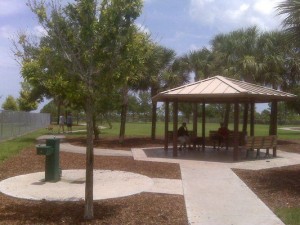

 Cultural Corner

 A Toledo, OH native, a graduate of
 As I Was Saying


 Mommy Moments
 Travel with Terri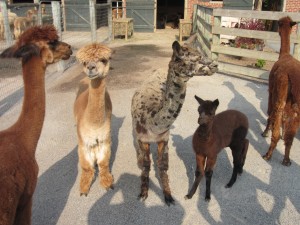

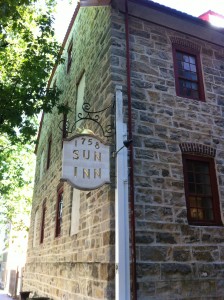 Moravian inn was known throughout the American Colonies for its gracious service, fine food and wines and comfortable suites.
